
FUE hair transplant
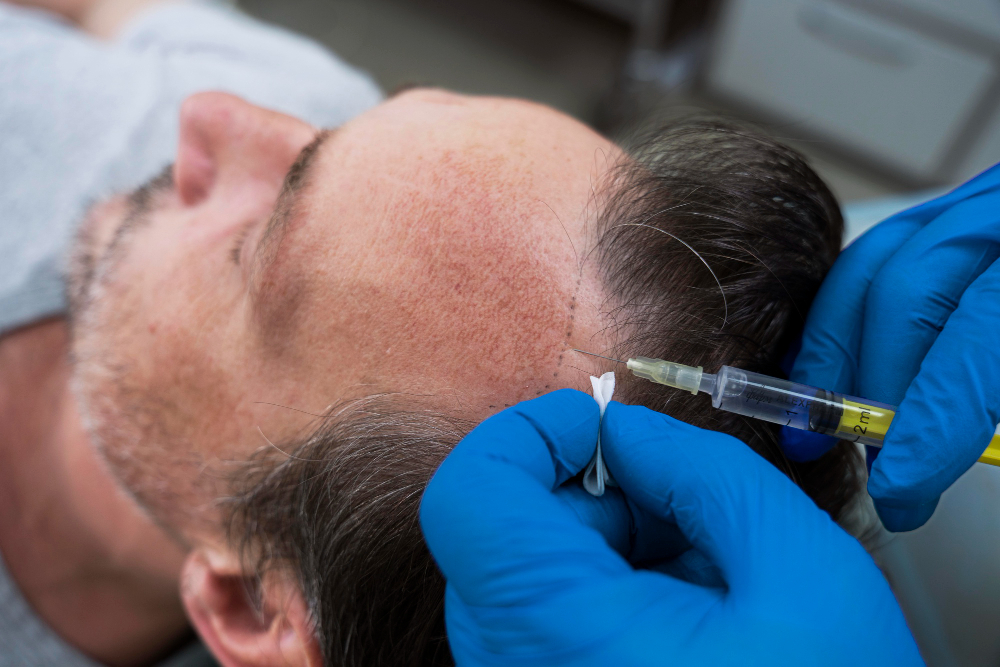
FUE Hair Transplant is one of the advanced hair restoration procedures available at our clinic. The treatment is designed to restore hair in areas affected by baldness, thinning, receding hairline, or reduced hair density. FUE stands for Follicular Unit Extraction, where individual hair follicles are taken from the donor area and implanted into the bald or thinning areas.
The fast pace of life, stress, genetics, hormonal changes, ageing, nutritional deficiencies, lifestyle habits, and scalp conditions can contribute to hair loss. In many patients, hair loss may gradually progress and lead to visible bald patches, receding hairline, thinning crown, or reduced confidence. FUE Hair Transplant helps improve hair coverage by using the patient’s own healthy hair follicles from the donor area.
FUE Hair Transplant is a minimally invasive hair restoration procedure that does not require a large cut or linear stitch. It is commonly chosen by men and women who want natural-looking hair restoration with better comfort and faster healing compared to traditional methods. At Ziva Skin and Hair Center, our dermatologist evaluates your scalp, hair loss pattern, donor area, and expectations before suggesting whether FUE Hair Transplant is suitable for you.
How long does FUE Hair Transplant result last?
The results of FUE Hair Transplant are usually long-lasting because the transplanted hair follicles are taken from the donor area, which is generally more resistant to hair loss. Once the transplanted hair grows properly, it can continue to grow naturally like normal hair.
After the procedure, some shedding of transplanted hair may occur in the first few weeks, which is a normal part of the hair growth cycle. New hair growth usually begins gradually over the next few months, and visible improvement may continue for 9 to 12 months or more. At Ziva Skin and Hair Center, our dermatologist will guide you on the expected timeline, hair growth stages, and maintenance care after the procedure.
Who is suitable for FUE Hair Transplant?
FUE Hair Transplant is suitable for patients who have bald patches, receding hairline, thinning crown, reduced hair density, or pattern hair loss that has not improved adequately with medicines or other treatments. It may also be suitable for people who want to improve facial hair areas such as beard, moustache, or eyebrows, depending on the case.
We are often asked who should consider FUE Hair Transplant. This treatment is commonly recommended for:
Male pattern baldness
Female pattern hair thinning
Receding hairline
Thinning crown area
Bald patches
Reduced hair density
Hair loss after injury or scars
Beard or moustache restoration
Eyebrow restoration in selected cases
Patients with good donor hair
Patients looking for natural hair restoration
Hair loss not responding to medical treatment
However, every patient’s hair loss condition is different. If you have active scalp infection, unstable hair loss, severe dandruff, alopecia areata, poor donor hair, uncontrolled medical conditions, or unrealistic expectations, it is important to consult the dermatologist before planning the procedure.
What will the treatment involve?
FUE Hair Transplant at Ziva Skin and Hair Center begins with a detailed scalp and hair evaluation. The dermatologist will check your hair loss pattern, donor area strength, scalp condition, hair density, medical history, and expectations. Based on this evaluation, the number of grafts, hairline design, donor area planning, and treatment suitability will be discussed.
During the procedure, the donor area is usually trimmed and cleaned. Local anaesthesia is given to numb the area and make the procedure comfortable. Individual hair follicles are then extracted carefully from the donor area using specialized instruments. These follicles are prepared and implanted into the bald or thinning areas according to the planned hairline and density.
The procedure may take several hours depending on the number of grafts required. FUE Hair Transplant is usually performed as an outpatient procedure and does not require hospital admission. After the procedure, our team will provide instructions for scalp care, medicines, washing routine, and follow-up visits.
Is FUE Hair Transplant safe?
FUE Hair Transplant is generally safe when performed by trained professionals under proper medical supervision. Since the procedure involves extraction and implantation of hair follicles, proper technique, sterile precautions, donor area planning, and hairline design are very important.
At Ziva Skin and Hair Center, FUE Hair Transplant is planned after understanding your hair loss stage, donor area quality, scalp health, medical history, and desired results. This helps reduce the risk of complications and improves the chances of natural-looking results. Patients should avoid undergoing hair transplant from unqualified providers, as poor technique may lead to unnatural hairline, poor growth, infection, or scarring.
Does FUE Hair Transplant hurt?
FUE Hair Transplant is usually comfortable because local anaesthesia is used before the procedure. The anaesthesia helps numb the donor and recipient areas so that the patient does not feel significant pain during follicle extraction and implantation.
Some patients may feel mild pressure, pulling, or vibration during the procedure. After the anaesthesia wears off, mild soreness, tightness, swelling, or tenderness may occur for a few days. These effects are usually temporary and can be managed with medicines and aftercare instructions advised by the dermatologist.
What happens after FUE Hair Transplant?
After FUE Hair Transplant, the treated scalp may have mild redness, swelling, tiny scabs, or sensitivity for a few days. The donor area and implanted area will heal gradually with proper care. Patients are advised to follow the washing instructions and avoid touching, scratching, or rubbing the transplanted area.
At Ziva Skin and Hair Center, our dermatologist will advise you to avoid strenuous exercise, sweating, direct sun exposure, smoking, alcohol, helmet use, and harsh hair products for the recommended period after the procedure. You may also be advised to sleep with your head slightly elevated for a few days to reduce swelling.
Transplanted hair may shed within the first few weeks, but this is usually temporary. New hair growth begins gradually, and density improves over several months. Regular follow-up visits help monitor healing and hair growth progress.
What are the possible side effects?
FUE Hair Transplant may have mild and temporary side effects. Some patients may experience redness, swelling, mild pain, itching, scabbing, tenderness, numbness, or tightness in the donor or recipient area. These effects usually settle with proper aftercare.
Rarely, infection, bleeding, poor graft growth, folliculitis, shock loss, uneven density, visible scarring, or delayed healing may occur. The risk of side effects can be reduced when the procedure is performed by trained professionals and when aftercare instructions are followed carefully.
At Ziva Skin and Hair Center, the treatment is planned according to your scalp condition, donor area, and hair restoration goals to ensure a safe and comfortable experience.
Who should not use FUE Hair Transplant?
If you are considering FUE Hair Transplant, you should always book a consultation with Ziva Skin and Hair Center. Certain conditions may require treatment first or may make the procedure unsuitable.
You may need special medical advice before FUE Hair Transplant if:
You have active scalp infection
You have severe dandruff or scalp inflammation
You have uncontrolled diabetes
You have bleeding disorders
You are taking blood-thinning medicines
You have poor donor hair availability
You have unstable or rapidly progressing hair loss
You have alopecia areata or autoimmune hair loss
You have a tendency to develop keloids
You have recently undergone scalp procedures
You have unrealistic expectations from the treatment
A proper consultation helps the dermatologist decide whether FUE Hair Transplant is suitable for your hair loss condition and whether any treatment should be done before the procedure.
Book an Appointment
If hair loss, bald patches, thinning crown, or receding hairline is affecting your appearance or confidence, FUE Hair Transplant can help restore natural-looking hair growth. Book your consultation at Ziva Skin and Hair Center to know whether FUE Hair Transplant is suitable for your hair and scalp condition.
Need Help
Our Clients Says
Trustindex verifies that the original source of the review is Google. GoodPosted on GoogleTrustindex verifies that the original source of the review is Google. I’m really impressed with my results. When I came to Dr., I was really hopeless, looking at my face. I had a lot of white heads blackheads , and hormonal acne, and then I couldn’t see any hope. When I meet the doctor within 6 to 7 months, I can see a drastic change in my face, and all the treatments Sir has provided are amazing. The laser treatment ,MNRF, CO2 has helped me a lot in becoming a more confident person. I will personally give the Dr a 5-star rating. Also, I will and I am still in touch with Dr wherever I am Dr. provides a video call consultation, so start your journey from right now, if you are the person who is facing a lot of problems.Posted on GoogleTrustindex verifies that the original source of the review is Google. One of the best skin & hair clinic I have known. I have referred many known people here and all have got best results. Dr. Harsha is the best one & all the staffs here are very friendly and professional at the same time.Posted on GoogleTrustindex verifies that the original source of the review is Google. Best clinic, best treatment ,very good Doctor and staffs , explains everything patiencely .Posted on GoogleTrustindex verifies that the original source of the review is Google. Had a really good experience at Ziva Clinic. The clinic is clean, professional, and the staff is very supportive and friendly. The treatment process was smooth, and they explain everything properly which makes you feel comfortable and confident. Special thanks to technician Manjunath for his excellent work and behaviour. He is very skilled, patient, and polite throughout the sessions. Really appreciated his professionalism and the way he handles clients. Highly recommended for anyone looking for quality derma treatments.